
Executive summary
The 182 MW solar plant in Bhavnagar, Gujarat, faces a unique set of operational hurdles. The site deals with two distinct types of dust. First, inland cementitious dust arrives from nearby quarries and heavy truck traffic. Second, a sticky coastal film forms due to marine salt and moisture. This combination creates very uneven soiling across the solar array. Strings near haul roads and quarry edges lose power much faster than others.
Local water access is a major problem for this site. Groundwater is scarce, and relying on water tankers is too expensive and unreliable. To solve this, Taypro deployed a fleet of HELYX semi-automatic robots. We used an OPEX service model to provide a reliable, waterless cleaning solution. This approach allows the O&M team to target high-soiling areas with precision.
The maintenance team performs scheduled dry cleaning cycles 3 to 10 times per month. These cycles depend on the actual dust levels in the environment. We use the NECTYR platform to log every single cleaning event. This provides full transparency for the plant owners. It allows finance teams to see exactly how cleaning activity affects the monthly Performance Ratio (PR). This data-driven strategy ensures the 182 MW plant maintains high energy yields in a harsh environment.
Environment and soiling at Bhavnagar, Gujarat
Environmental Challenges and Soiling Profiles at the Bhavnagar 182 MW Asset
The 182 MW plant in Bhavnagar sits in a complex environmental zone. Its location near the Gujarat coastline creates a dual-threat soiling profile. Standard cleaning protocols often fail here because the dust is not uniform. The site must manage two very different types of contaminants at the same time.
The first threat comes from inland activities. Nearby quarries and heavy vehicle traffic on haul roads create large amounts of coarse dust. This dust is cementitious in nature. These abrasive particles settle on the glass and cause rapid shading. Because these roads are right next to the solar arrays, the strings closest to them degrade much faster than the rest of the plant.
The second threat is the coastal atmosphere. Moisture in the air carries marine salts toward the plant. These salts create a sticky, hydrophobic film on the module surfaces. This film acts like an adhesive. It traps the heavy mineral dust and holds it in place. Once the dust is stuck, natural wind cannot blow it away. This makes the soiling much harder to remove than standard dry dust.
Water scarcity makes the situation even more difficult. Groundwater is limited in this region. Using water tankers to wash 182 MW of panels is not a sustainable plan. It is too costly and the logistics are too hard to manage. The Taypro OPEX model solves these issues through three main methods:
- Precision Deployment: The team uses HELYX robots to focus on high-loss areas. They prioritize rows near haul roads and quarries. This optimizes labor and ensures the most critical areas stay clean.
- Adaptive Cadence: Cleaning is not done on a rigid calendar. Instead, teams perform 3 to 10 dry cleaning cycles every month. They adjust the frequency based on real-time dust levels.
- Financial Accountability: Every cleaning cycle is recorded in NECTYR. This allows stakeholders to see the direct link between cleaning and energy production.
By using a waterless strategy, the site avoids the high costs of manual washing. This targeted approach turns a difficult environmental challenge into a predictable operational cost. You can learn more about our specific methods in our cleaning technology guide.
O&M before Taypro
Managing Water Scarcity and PR Variance in Bhavnagar
Running a 182 MW site in Bhavnagar is a constant struggle for O&M teams. The local climate requires frequent cleaning to keep power output high. However, the region lacks sufficient groundwater. Before Taypro, the plant relied on tanker-based wet cleaning. This method created massive logistical headaches and high costs.
If water deliveries were late, the cleaning schedule stopped immediately. This caused the Performance Ratio (PR) to drop quickly. For large solar investors, these gaps create a major financial problem. Without a verified cleaning log, it is hard to explain why energy production fluctuates. Plant managers often had to guess the impact of soiling. This made long-term budget planning very difficult for the finance teams.
The 182 MW project needed a new way to manage these risks. They required a system that could work without water and provide real data. The project focused on three key goals:
- Water Independence: Moving to autonomous robots removed the need for water tankers. The plant no longer depends on unpredictable water supplies.
- Verifiable Operations: The new system provides a granular record of all maintenance. This allows finance teams to correlate cleaning events with PR performance.
- Labor Optimization: Automation reduces the need for large manual cleaning crews. This lets the staff focus on high-value system management and oversight.
This shift to a data-backed framework changed how the site operates. The O&M team can now maintain high output even in a water-stressed environment. They also provide the full transparency that modern utility-scale investors demand.
Fleet and deployment at 182 MW
Optimizing 182 MW Through Strategic Deployment of HELYX Systems
The deployment strategy for the 182 MW Bhavnagar project focuses on high-precision cleaning. We do not treat every row the same way. The soiling at this site is very uneven. We know that the cementitious dust and coastal film settle more heavily in specific zones. Therefore, we chose a targeted semi-automatic approach.
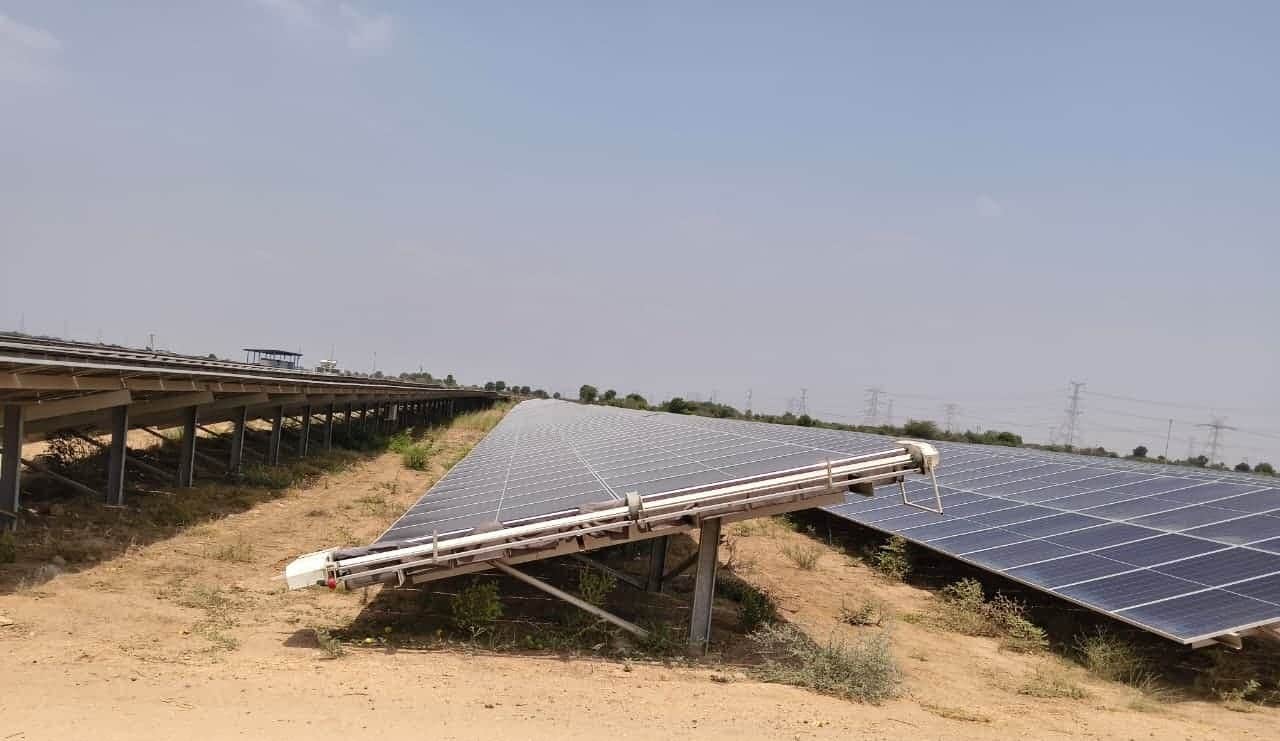
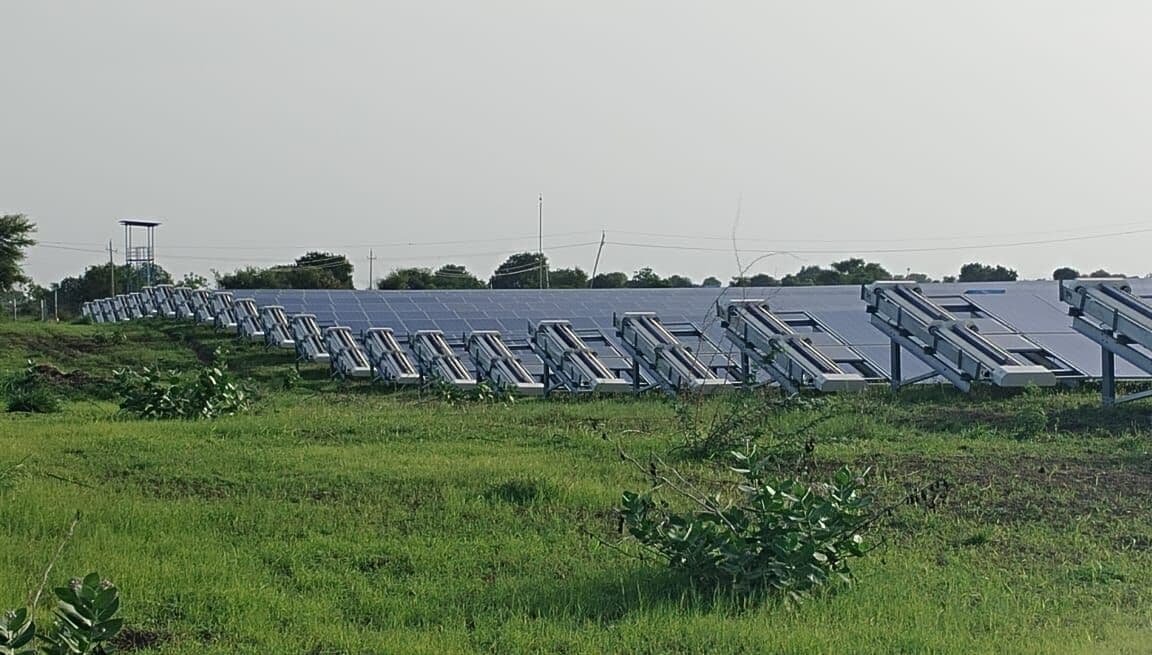
The core of our fleet is the HELYX robot. These are pick-and-place, semi-automatic cleaning units. They are perfect for sites with scattered blocks or uneven cleaning needs. Instead of covering the whole site with expensive full-row automation, we use HELYX to target the highest-loss strings. We focus our resources on the rows near the quarries and the haul roads.
Each HELYX unit is built for this specific task. They feature several key technical specifications:
- Single-Pass PBT Cleaning: The robots use UV-stable PBT brushes. These brushes perform a single-pass cleaning cycle. They are effective at removing abrasive cementitious dust without scratching the glass.
- Pick-and-Place Flexibility: The HELYX system can move between different blocks and string clusters. This makes it ideal for the complex layout of the Bhavnagar site.
- High Efficiency: Each robot travels at a speed of 10 to 15 metres per minute. They can clean up to 3 km on a single charge.
- Durable Build: The robots are lightweight at 39 kg, making them safe for the modules. They also feature fall prevention technology.
We manage the entire fleet through the NECTYR portal. This allows us to follow an OPEX procurement model. The asset owner does not need to pay a large upfront cost for the robots. Instead, the service includes skilled manpower and a rotation of robot units. The robots are moved across the site based on real-time telemetry. This ensures that the most soiled areas always get priority.
The cleaning cadence is also carefully managed. Operators follow a schedule of 3 to 10 dry cleaning cycles per month for the targeted zones. We adjust this frequency based on regional weather data. This ensures we are always ahead of the dust accumulation. For more information on our models, see our cleaning systems overview.
Operations and monitoring
Optimizing Cleaning Cadence and Performance Tracking
Success at the 182 MW Bhavnagar plant depends on discipline. We must balance the heavy soiling with a predictable maintenance budget. We avoid the mistake of thinking every module needs daily washing. On a site this large, daily washing is neither sustainable nor necessary. Instead, we use a much smarter, inspection-led approach.
Our operational strategy is built on four main pillars:
- Strategic Cleaning Cadence: We maintain a targeted rhythm of 3 to 10 dry cleaning cycles per month. We direct more intensity toward strings near the roads and quarries. This prevents the most severe dust from ever settling deeply.
- Inspection-Led Accountability: We do not clean based on a simple calendar. The NECTYR platform guides our cleaning events. It uses real-time site data to tell us exactly when and where to deploy the HELYX robots. This reduces unnecessary wear on the equipment.
- Wind Hold Protocols: High winds can be dangerous for cleaning robots. NECTYR provides precise weather telemetry. It triggers automated wind holds to keep the robots safe. This protects the fleet during heavy dust storms.
- Financial Transparency: Large IPP portfolios require clear data. By logging every event in NECTYR, we provide a perfect audit trail. Finance departments can see the exact link between cleaning and the recovery of lost generation.
This automated oversight ensures the 182 MW fleet stays at peak efficiency. We do not rely on the heavy water use typical of older methods. By integrating autonomous robots with digital management, we protect the long-term ROI of the Gujarat site. You can explore how our software works via the NECTYR fleet portal.

Results and impact
Stabilizing Performance Ratio through Data-Backed Cleaning
The 182 MW Bhavnagar site has seen significant improvements since moving to the Taypro system. The transition to a semi-automatic cleaning strategy has solved the problem of uneven dust accumulation. We have successfully neutralized the sharp drops in the Performance Ratio (PR) that used to happen during peak dust months. The plant now produces energy much more consistently.
The impact of this deployment can be seen in three main areas:
- Stabilized Energy Yield: The data-driven cleaning schedule keeps the modules clear. This ensures that actual energy generation stays close to the forecasted potential. The regional soiling no longer causes massive, unpredictable power losses.
- Operational Accountability: There is no more guesswork for the stakeholders. Finance teams now receive clear, evidence-based cleaning logs through NECTYR. They can directly correlate cleaning activity with energy recovery. This makes it easy to justify the OPEX spend.
- Optimized Resource Allocation: We no longer waste water or labor on clean panels. The team focuses only on high-soiling zones. This targeted approach protects the solar modules from unnecessary contact while keeping the most critical areas clear.
This deployment proves that large-scale solar assets can thrive in harsh environments. By replacing manual guesswork with autonomous precision, the Bhavnagar project has set a new standard. We have moved from reactive cleaning to proactive, data-backed maintenance. This protects the long-term health and profitability of the asset.
Peer comparison and planning checklist
Peer Benchmarking and Deployment Planning
The 182 MW Bhavnagar site is a key part of the Gujarat solar landscape. It aligns with other major regional projects, such as the 300 MW Bachau and the 250 MW Neneva plants. These sites are benchmarks for utility-scale operations in the state. While those larger sites use various automation levels, Bhavnagar addresses a very specific problem: heterogeneous dust. We have validated that the mix of cementitious dust and coastal film requires a localized, zone-based strategy.
Moving from manual labor to robotic integration requires careful planning. To replicate our success, site managers should follow a structured framework. We recommend the following checklist for integrating Taypro solutions into your OPEX workflow:
- Perform a Soiling Gradient Audit: Map your site to find high-accumulation zones. Look for areas near haul roads, quarries, or boundaries. These are the zones where semi-automatic robots will provide the fastest ROI.
- Define the Cleaning Cadence: Do not use a one-size-fits-all schedule. Establish a recurring rhythm that accounts for local dust levels. Ensure your NECTYR dashboard is set up to log every cycle for your finance reports.
- Verify Site Access and Infrastructure: Check that there is enough space at the end of the rows for robot docking. Ensure your maintenance teams are trained on how to move the HELYX units safely.
- Standardize Your Reporting: Use the telemetry from NECTYR to track your progress. Monitor metrics like water saved and MWh recovered. This provides the data you need for future scaling decisions.
Planning for the future should also include a cost analysis. We recommend using our ROI price calculator to estimate your payback period. If you are deciding between models, our CAPEX vs OPEX guide can help you choose the best procurement path for your portfolio.