
Executive summary
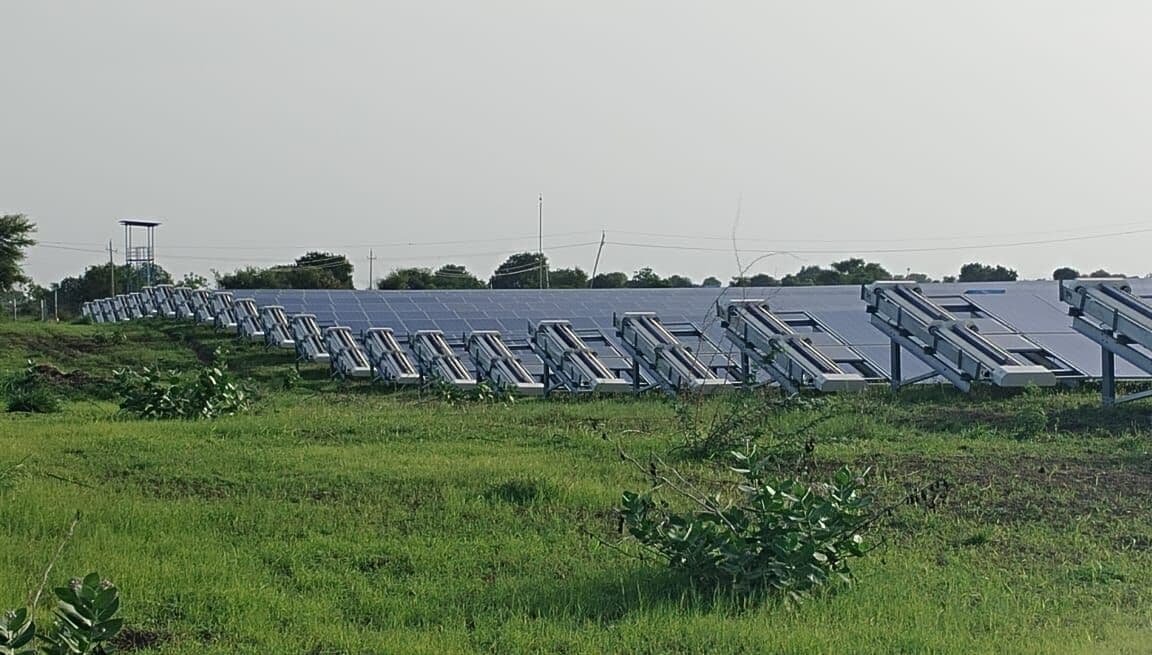
Located in Bhuj, Gujarat, this 50.51 MW utility-scale solar site faces complex soiling challenges driven by inland cementitious dust and coastal film accumulation. Haul roads and quarry-adjacent strings experience rapid degradation, creating significant performance disparities across the array. Traditional wet cleaning methods were constrained by limited groundwater and tanker availability during peak dust months, necessitating a more sustainable, high-frequency Opex approach.
Taypro deployed the HELYX semi-automatic waterless robotic system to address these site-specific conditions. By integrating NECTYR-logged cleaning cadences, the project transition enables transparent reporting of month-to-month PR variance to finance teams. The fleet performs roughly 3–10 dry cleaning cycles per month based on real-time soiling data, ensuring consistent energy yield. This deployment provides a scalable, waterless solution that mitigates uneven soiling while providing the operational accountability required for large-scale IPP portfolio management.
Environment and soiling at Bhuj, Gujarat
Managing Heterogeneous Soiling in Bhuj: Addressing Cementitious and Coastal Dust
The 50.51 MW Bhuj site operates within a challenging micro-climate defined by two distinct soiling vectors. Inland, the facility is subjected to heavy cementitious dust from nearby industrial activity, while coastal proximity introduces a persistent film of salt-laden moisture. This combination creates highly variable soiling patterns across the array.
Strings located near quarry borders and primary haul roads face significantly faster degradation than modules in protected zones. This spatial variance creates uneven PR (Performance Ratio) across the portfolio, which complicates standard manual cleaning schedules. Because the site is situated in a region with restricted groundwater and limited tanker logistics, wet washing is neither sustainable nor cost-effective for year-round operations.
To solve these issues, the facility utilizes a structured Opex approach for robotic cleaning. By deploying the HELYX system, the plant maintains a responsive cadence that targets the most heavily soiled strings first. NECTYR provides the granular logging necessary to explain fluctuations in energy output to finance stakeholders. This visibility ensures that the cleaning frequency remains aligned with real-time site conditions rather than arbitrary calendar intervals, protecting the asset from long-term efficiency losses.
O&M before Taypro
Managing Heterogeneous Soiling in Bhuj: The Shift from Unreliable Wet Washing
The 50.51 MW Bhuj site faces intense operational complexity due to its unique micro-climate. The facility struggles with localized cementitious dust from nearby industrial zones and a persistent, sticky film generated by coastal humidity. This environment creates high spatial variance in soiling, where modules located near quarry boundaries and heavy-traffic haul roads experience degradation significantly faster than the rest of the array.
Before implementing Taypro’s autonomous robotics, the site relied on traditional wet washing methods that were increasingly untenable. Operational challenges included:
- Resource Constraints: Extreme scarcity of local groundwater and the high volatility of water tanker availability made consistent wet cleaning impossible during peak dust months.
- Accountability Gaps: The absence of a systematic, logged cleaning cadence made it difficult for operations teams to justify month-to-month performance ratio (PR) variance to finance stakeholders.
- Inefficient Labor: Manual cleaning cycles could not keep pace with the specific, rapid soiling of high-exposure strings, leading to localized energy yield losses.
These persistent O&M hurdles necessitated a transition toward data-driven, waterless robotic operations to stabilize energy generation and improve asset-level transparency.
Fleet and deployment at 50.51 MW
Fleet and Deployment Strategy at 50.51 MW
The 50.51 MW Bhuj facility utilizes a specialized fleet of HELYX pick-and-place robots, integrated under an Opex procurement model. This configuration addresses the site's distributed block layout, which is fragmented by haul roads and quarry-adjacent boundaries. The HELYX fleet allows site personnel to prioritize cleaning resources on the most degraded strings that suffer from rapid cementitious and coastal dust accumulation.
The deployment focuses on a semi-automatic cleaning cadence, optimized to address high-soiling zones with approximately 3–10 dry cycles per month. This frequency is dynamically managed based on real-time site access and environmental conditions. By leveraging the portable nature of the HELYX units, the site maintains a responsive coverage map that balances cleaning intensity with the logistical constraints of the plant topography.
Commissioning emphasis centers on NECTYR fleet monitoring, which provides the precise logging required for asset management. This system captures granular data on every cleaning cycle, creating a verifiable audit trail for month-to-month performance ratio variance. By transitioning from manual intervention to a standardized Opex robotics program, the Bhuj project ensures consistent yield recovery. This data-backed approach allows plant operators to justify cleaning expenditures to finance stakeholders, moving away from legacy wet-washing cycles that proved unreliable in this water-constrained region of Gujarat.
Operations and monitoring
Operations and Monitoring at the Bhuj Site
The 50.51 MW Bhuj facility shifts from unpredictable manual cleaning to a structured, inspection-led accountability model. By utilizing HELYX pick-and-place robots, the operations team targets specific high-soiling strings, particularly those bordering quarries where cementitious dust accumulation is most aggressive. This surgical approach ensures that localized degradation is mitigated before it impacts site-wide performance ratios.
Operations are governed by a strictly logged cleaning cadence, averaging 3–10 dry cleaning cycles per month. This schedule is managed directly via the NECTYR fleet portal, providing real-time transparency for finance teams to correlate specific cleaning interventions with yield recovery. This system eliminates the inconsistencies associated with legacy wet-washing, which was frequently hampered by regional groundwater shortages and tanker logistical constraints.
To ensure asset protection, the team implements mandatory wind holds during high-velocity weather events, with site protocols automatically updated through NECTYR. This integration moves the plant beyond the myth of daily washing, replacing it with a data-driven strategy that prioritizes cleaning when it is most effective for the P&L. Through this semi-automatic protocol, the Bhuj project maintains a verifiable audit trail of all maintenance activities.
Results and impact
Data-Driven Yield Recovery at the 50.51 MW Bhuj Site
The transition to waterless robotic cleaning at the Bhuj facility has fundamentally altered the site’s approach to asset management. By moving away from manual water-based washing, the IPP has eliminated dependence on erratic tanker schedules and regional groundwater limits. The shift to a standardized, logged robotic cleaning program provides the verifiable audit trail required to explain monthly Performance Ratio (PR) fluctuations to finance stakeholders.
The impact of this program is most visible in how the team manages uneven soiling patterns. By deploying HELYX robots to target strings adjacent to haul roads and quarries, the team prevents accelerated module degradation caused by abrasive cementitious dust. This targeted cleaning strategy ensures that high-risk modules receive consistent attention without the logistical strain of site-wide wet-cleaning.
- Consistent data logs justify cleaning expenditures based on actual site-wide yield performance.
- Waterless cycles mitigate the long-term impact of abrasive quarry dust on module coatings.
- Automated reporting via NECTYR eliminates the inconsistency of legacy manual records.
- Targeted cleaning protects ROI by focusing resources on the most heavily impacted strings.
Peer comparison and planning checklist
Peer Comparison and Operational Strategy
The 50.51 MW Bhuj project serves as a regional benchmark for utility-scale O&M, contrasting with the 300 MW Bachau and 250 MW Neneva deployments. While those larger portfolios often integrate fully autonomous, high-throughput systems across flat terrain, the Bhuj site requires a nuanced approach due to localized cementitious dust and coastal film. Similar to the 50 MW Maya-Gujarat project, this deployment prioritizes operational flexibility to manage uneven soiling while balancing groundwater constraints.
By shifting from manual, inconsistent washing to a semi-automatic model, the Bhuj project avoids the logistical bottlenecks that typically constrain 50-MW class assets in arid zones. The following checklist ensures site teams maintain optimal performance while adhering to strict financial and water-saving mandates.
- Establish a baseline NECTYR log to map PR variance against regional wind and dust patterns.
- Prioritize HELYX deployments on strings nearest to haul roads and quarry boundaries.
- Schedule 3 to 10 dry cycles per month based on real-time soil accumulation metrics.
- Integrate automated wind-hold protocols to protect robotics during extreme weather events.
- Audit monthly cleaning expenditures against site-wide energy yield data to confirm ROI.