
Executive summary
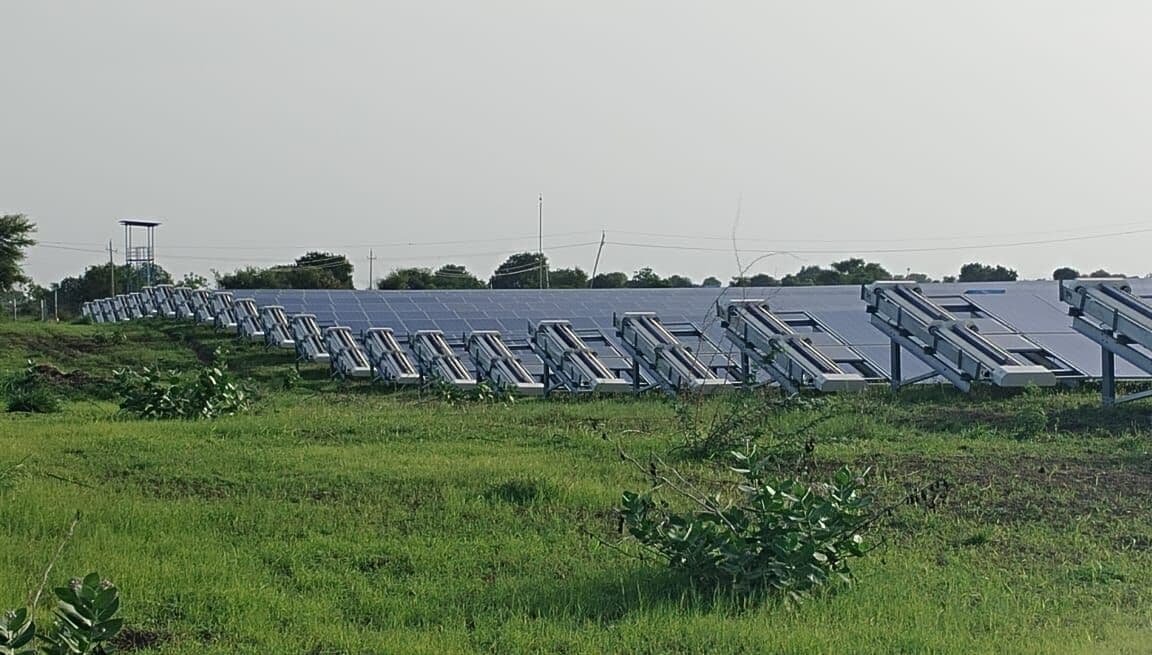
This 100 MW semi-automatic solar plant in Jamnagar, Gujarat, operates within a challenging environmental intersection. The site experiences significant soiling accumulation from inland cementitious dust generated by nearby quarries, compounded by a persistent coastal film. This dual-source contamination creates highly uneven soiling patterns across the array. Strings positioned along haul roads and near quarry boundaries suffer from accelerated performance degradation compared to the rest of the site, complicating energy yield forecasting for the IPP owner.
To address these constraints, the project transitioned from traditional water-dependent washing to a structured robotic deployment. Utilizing the HELYX semi-automatic system, the site now executes a rigorous dry cleaning cadence of 3–10 cycles per month. This transition mitigates the logistical risks associated with scarce groundwater and unreliable tanker availability. By integrating NECTYR logs into the operational workflow, the finance team can now reconcile month-to-month performance ratio variance with clear, verifiable cleaning data. This deployment provides the site with a scalable, sustainable path to maintaining optimal plant health despite complex regional soiling pressures.
Environment and soiling at Jamnagar: 100 MW Semi
Managing uneven soiling at Jamnagar 100 MW: Quarry dust and coastal films
The 100 MW semi-automatic solar site in Jamnagar, Gujarat, faces a unique set of operational hurdles. The facility contends with two distinct types of environmental degradation. Inland cementitious dust travels from nearby quarries, while a sticky film forms due to marine salt and high coastal humidity.
This dual-source contamination results in highly uneven soiling across the solar array. Strings located near haul roads and quarry edges suffer from faster power degradation than those in shielded sectors. This creates significant performance ratio (PR) variance that previously proved difficult for asset managers to quantify or control.
Groundwater scarcity and unreliable tanker logistics make repeatable wet washing unsustainable during peak dust months. To solve this, the plant transitioned to a structured robotic Opex model using the HELYX system. Key operational shifts include:
- Deployment of a consistent cleaning cadence of 3–10 dry cycles per month to combat localized dust accumulation.
- Replacement of inconsistent manual wet cleaning with standardized dry robotics to preserve water resources.
- Integration of NECTYR software to provide the granular, logged cleaning data required for finance-grade reporting.
By shifting to semi-automatic waterless cleaning, the site effectively decouples its energy yield from the limitations of the local water supply. The move ensures that quarry-adjacent modules receive necessary attention without the high logistical costs of traditional tanker-based labor.
O&M before Taypro
Managing uneven soiling at Jamnagar 100 MW: Quarry dust and coastal films
The 100 MW semi-automatic solar site in Jamnagar, Gujarat, faces unique operational hurdles. The facility contends with two distinct types of environmental degradation. Inland cementitious dust travels from nearby quarries, while a sticky film forms due to marine salt and coastal humidity.
This dual-source contamination results in highly uneven soiling across the solar array. Strings located near haul roads and quarry edges suffer from faster power degradation than those in shielded sectors. This creates significant performance ratio (PR) variance that previously proved difficult for asset managers to quantify or control.
Groundwater scarcity and unreliable tanker logistics make repeatable wet washing unsustainable during peak dust months. To address these gaps, the plant required a shift toward a structured Opex model. The previous reliance on manual intervention created three core challenges for the operations team:
- Unpredictable PR drops caused by unlogged or delayed cleaning cycles.
- Logistical bottlenecks due to local groundwater scarcity and high tanker dependency.
- Difficulty justifying cleaning expenditure to finance stakeholders without verifiable performance data.
By shifting to an autonomous, data-driven approach, the site effectively decouples its energy yield from the limitations of the local water supply. This transition ensures that quarry-adjacent modules receive necessary cleaning attention without the high logistical costs of traditional manual labor.
Fleet and deployment at 100 MW
Fleet mix and deployment strategy for 100 MW site efficiency
To address the 100 MW Jamnagar site requirements, Taypro implemented a fleet of HELYX pick-and-place robots. This selection was based on the need for a portable solution capable of navigating scattered utility-scale plant blocks and addressing highly variable soiling patterns. HELYX robots utilize single-pass PBT brush technology, which is effective for the abrasive, cementitious dust found in this Gujarat region.
The deployment utilizes an Opex-based procurement model. This service-oriented approach allows the asset owner to scale resources according to real-time performance data without the burden of capital expenditure. By integrating the NECTYR operations portal, the fleet enables the site management team to maintain a logged cleaning cadence of approximately 3 to 10 dry cycles per month, weather and access permitting. This granularity is critical for explaining month-to-month PR variance to finance teams.
Commissioning focused on the specific operational bottlenecks of the Jamnagar landscape. Because the site layout features sections exposed to quarry dust and coastal film, the deployment prioritized the training of skilled manpower to rotate the HELYX units effectively across high-degradation strings. This pick-and-place methodology ensures that high-impact areas receive consistent robotic attention, effectively replacing the previous reliance on unreliable, water-intensive tanker operations.
The fleet setup provides a scalable operations layer that supports the entire 100 MW capacity. By removing the need for manual water-based scrubbing, the current deployment achieves higher cleaning efficiency while reducing operational risks associated with heavy traffic and site access. This structured Opex approach provides a verifiable record of cleaning activities, directly supporting the reporting requirements of large IPP portfolios.
Operations and monitoring
Managing cleaning cadence and site accountability in Jamnagar
The 100 MW Jamnagar site presents complex challenges, ranging from inland cementitious dust to coastal film accumulation. High-frequency cleaning is essential to prevent permanent shading and long-term degradation, particularly along quarry-adjacent strings and haul roads. To maintain site performance, operations teams rely on NECTYR for inspection-led accountability. By shifting from ad-hoc manual tasks to a disciplined robotic schedule, the plant ensures cleaning logs directly correlate with monthly PR reporting for finance.
Operations at this site are structured around a reliable 3–10 dry cycle per month schedule using the HELYX pick-and-place fleet. This cadence allows the team to bypass the logistical constraints of local groundwater and the high costs of water-based tanker delivery. Our operational framework incorporates specific protocols to manage site variables:
- NECTYR-led scheduling: Data from the fleet identifies high-soiling zones, allowing the team to deploy robots where they add the most generation value.
- Wind hold protocols: Integrated sensors ensure that robots are docked during extreme weather events to protect equipment and ensure safety across the arrays.
- Inspection-led adjustments: Managers use visual verification to adjust the monthly cleaning cycle based on actual dust buildup rather than arbitrary calendar dates.
This approach moves beyond the myth of daily wash cycles, which are often inefficient and water-intensive in this region. Instead, the focus remains on consistent, autonomous dry cleaning that sustains high performance throughout the peak dust season.

Results and impact
Quantifiable stability through NECTYR telemetry
The transition to a robotic maintenance strategy at the 100 MW Jamnagar site has fundamentally altered how the project team manages performance variability. By integrating the HELYX robotic fleet with NECTYR, the asset management team has successfully bridged the gap between operational output and financial reporting. The system provides a transparent audit trail of every cleaning cycle, ensuring that fluctuations in performance ratio are no longer attributed to guessing, but to verified cleaning events.
The impact of this deployment extends beyond simple dust removal. By aligning the cleaning cadence with real-time soiling trends in Gujarat, the project has achieved significant improvements in consistency. This data-driven approach allows for precise justification of Opex expenditure to stakeholders, proving the efficacy of waterless cleaning in environments where traditional washing is logistically impossible.
- Enhanced PR predictability: Standardized logging through NECTYR allows finance teams to account for monthly PR variances with greater confidence.
- Resource optimization: By replacing water-dependent cleaning with waterless robotic cycles, the site has eliminated its reliance on costly and erratic tanker logistics.
- Strategic targeting: Operations teams focus limited deployment time on high-degradation zones like quarry-adjacent strings, ensuring that every robot movement contributes to maximum generation recovery.
This disciplined approach to site maintenance has established a scalable model for large IPP portfolios across the region. By moving to a verifiable, performance-linked cleaning schedule, the Jamnagar plant maintains operational excellence despite the challenging inland and coastal dust profiles.
Peer comparison and planning checklist
Benchmarking Jamnagar: Regional deployment insights
The 100 MW Jamnagar deployment operates under conditions similar to the 300 MW Bachau and 250 MW Neneva projects in Gujarat. Like these larger sites, Jamnagar experiences the dual impact of inland cementitious dust and coastal film, which causes uneven soiling and rapid performance degradation along haul roads. While the larger sites often utilize fully autonomous, large-scale robotic arrays to manage continuous soiling, Jamnagar uses a semi-automatic approach to accommodate specific resource constraints.
Comparing the 100 MW site to regional peers highlights the necessity of localized cleaning strategies. Projects like Bachau and Neneva leverage high-density robotic coverage to mitigate dust-related PR variance across vast arrays. At the 100 MW Jamnagar plant, the focus remains on high-frequency, targeted cycles to prevent the cementitious buildup that characterizes this specific geographic belt. By analyzing the performance logs from these peer sites, Jamnagar maintains an optimized cleaning cadence that balances the logistics of semi-automatic deployment with the output demands of an IPP-scale asset.
Peer comparison and planning checklist
- Audit daily PR trends against regional peer data from the Bachau and Neneva deployments.
- Map high-soiling zones, specifically quarry-adjacent strings and haul road perimeters, for prioritized cleaning paths.
- Establish a 3–10 cycle monthly cleaning cadence tailored to seasonal dust intensity and local groundwater constraints.
- Integrate NECTYR telemetry to log every cycle, ensuring finance teams can reconcile PR shifts with cleaning activity.
- Schedule regular inspections of robot mechanical components to sustain uptime during peak dust months.