Quick answer for plant managers
Choosing between lease and purchase models for solar cleaning robots depends on your site scale, CAPEX availability, and long-term O&M strategy. Outright purchase (CAPEX) is generally optimal for 50MW+ utility-scale sites where internalizing the O&M fleet reduces long-term operational expenditure. Leasing or choosing a service-based model is more effective for mid-scale portfolios or projects where maintaining lean balance sheets and minimizing technical risk are the top priorities.
- Lease (OPEX) is preferred for rapid deployment and low upfront budget impact in C&I segments.
- Buy (CAPEX) is more cost-effective for 50MW+ utility sites with stable, long-term O&M budgets.
- Typical soiling loss in Rajasthan and Gujarat ranges from 0.5% to 1.0% per day if unmanaged.
- Annual energy yield reduction can reach 15% to 25% due to unmanaged soiling in high-dust zones.
- Automated systems can reduce water consumption by up to 90% compared to traditional manual cleaning.
How do financing models for cleaning robots lease buy impact utility-scale operations?
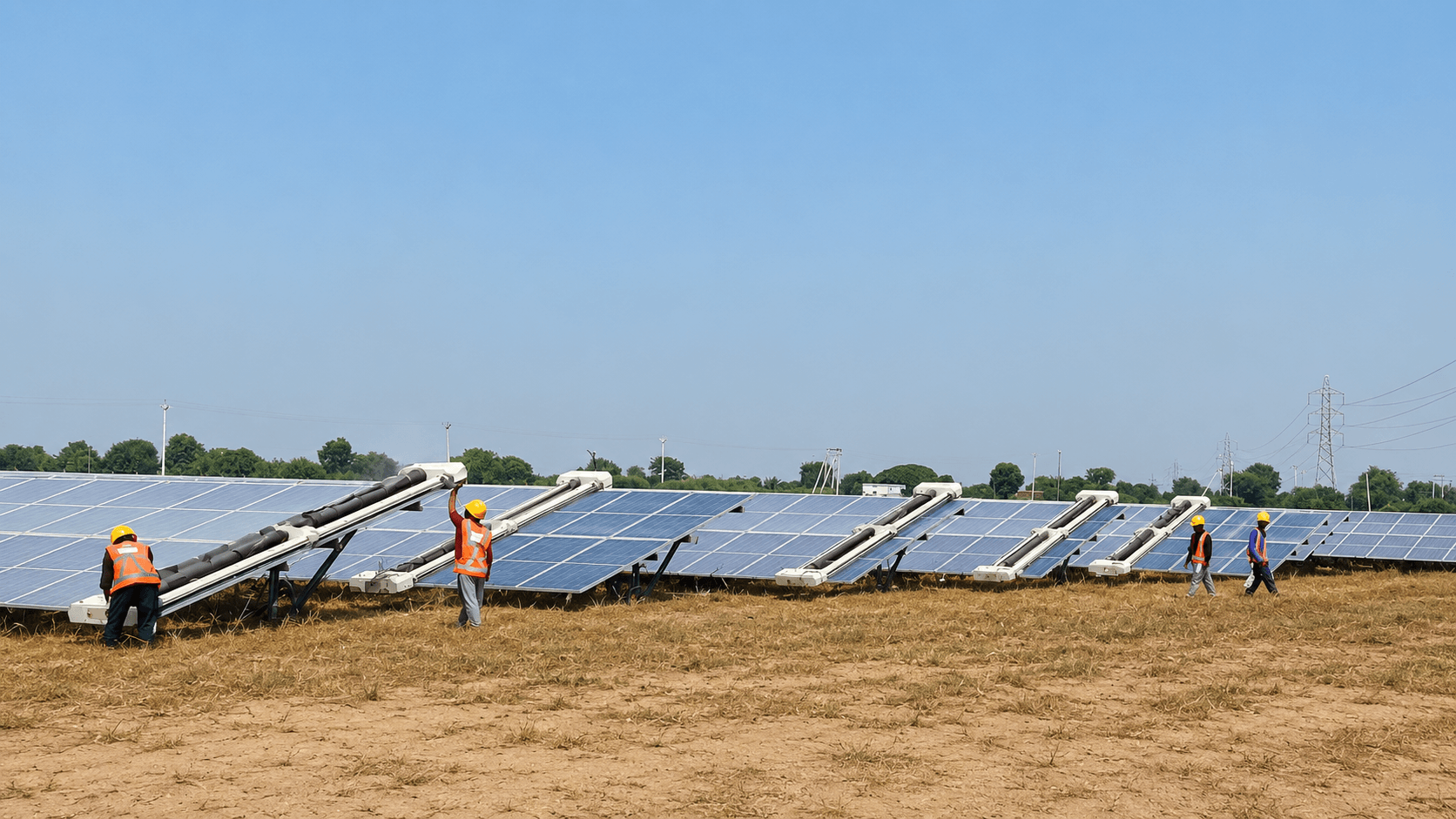
The choice between leasing and buying cleaning robots directly impacts how an Indian utility-scale plant manages its automatic solar panel cleaning system. An outright purchase shifts the responsibility of maintenance, spares, and firmware updates entirely to the site O&M team. For asset owners managing a 50 MW to 100 MW site, this model allows for tighter control over the cleaning frequency, which is vital when addressing regional soiling variations. Our data at Taypro shows that aligning cleaning cycles with local dust patterns is the most efficient way to maintain PR on Indian utility plants.
Conversely, a lease or service-based model shifts the technical burden to a specialized provider. This approach is increasingly popular for newer projects that prioritize predictable OPEX over the risk of managing hardware fleets. By engaging a service partner, the site manager gains access to the latest robotic technology without managing the lifecycle of batteries, brushes, or internal sensors. For smaller or distributed plants, this model avoids the overhead of training staff on specific robotic diagnostics and fleet software, such as the NECTYR fleet portal, allowing site teams to focus on core grid and inverter performance.
The CAPEX model: Buying robots for long-term O&M control
Outright purchase of robotic cleaning systems is the preferred model for large-scale utility projects where asset longevity and operational control are paramount. For 50MW+ sites, capital investment in robotics, such as the GLYDE or NYUMA series, allows plant owners to depreciate the equipment over its useful life, typically aligned with the PPA term. This approach eliminates recurring service fees, providing a fixed cost structure that is highly attractive for institutional investors focusing on long-term IRR.
Technical control is the primary benefit of ownership. When the robot fleet belongs to the site, your internal O&M team maintains full authority over cleaning schedules, firmware updates, and maintenance priorities. This is critical for sites in high-soiling zones where a delayed cleaning cycle can result in a 0.5% to 1.0% drop in daily PR. With your own hardware, you can trigger specific row-level cleaning tasks during low-generation hours or peak soiling events without negotiating service windows with a third-party provider.
The OPEX model: Leasing or cleaning-as-a-service (CaaS) implementation
For IPPs managing distributed portfolios or sites with constrained upfront capital, the Cleaning-as-a-Service (CaaS) model shifts the procurement burden away from CAPEX. Under this structure, a vendor supplies the robotic fleet and manages the lifecycle performance as an operating expenditure. This arrangement is particularly effective for C&I projects or newer 10–25 MW portfolios where the goal is to keep the balance sheet lean while ensuring a consistent, high-performance cleaning standard.
The CaaS model is structured to prioritize uptime rather than equipment management. Service partners assume responsibility for battery replacements, brush wear, and connectivity issues through the NECTYR fleet portal, ensuring that the asset owner receives an SLA-backed generation guarantee. This model removes the need for in-house robotic training and technical diagnostics, effectively outsourcing the risk of robotic fleet management. For operators concerned about the 15% to 25% annual yield reduction seen in unmanaged sites, this service-led approach provides an immediate performance uplift without the administrative overhead of managing mechanical repairs or spare part logistics.
Technical decision matrix: Lease vs Buy for Indian solar sites
Choosing between an outright purchase and a service-based model requires evaluating site-specific variables such as module technology, soiling intensity, and the maturity of your current O&M workflow. A technical decision matrix helps align procurement with your site requirements to ensure high performance while maintaining budget predictability.
| Decision Criterion | Buy (CAPEX) | Lease / Service (OPEX) |
|---|---|---|
| Site Scale | 50 MW+ portfolios | 5–25 MW or distributed sites |
| Fleet Control | High; internal management | Low; vendor-managed |
| Tech Obsolescence | Buyer assumes risk | Vendor assumes risk |
| Deployment Speed | Longer procurement cycles | Rapid implementation |
| Cost Profile | High upfront; zero recurring | No CAPEX; predictable annual fees |
For large-scale utility projects in high-dust corridors like Rajasthan, the Buy model allows your engineering team to standardize robotic equipment across the site. This enables seamless integration with your existing SCADA or NECTYR fleet portal, ensuring that cleaning cycles are synchronized with local grid demand and weather forecasting. Owning the hardware provides the flexibility to perform additional cleaning passes during extreme soiling events without incurring extra service charges.
Conversely, the Lease model is best suited for C&I projects or portfolios where dedicated, on-site robotic technicians are not viable. By opting for a service agreement, you leverage the vendor’s expertise to maintain the fleet, manage battery health, and handle firmware updates. This reduces the administrative burden on your site O&M teams, allowing them to focus on module integrity and inverter performance rather than mechanical troubleshooting. Before selecting a model, conduct a 30-day pilot on a representative block to verify the impact of the chosen cleaning method, whether dual-pass microfiber or single-pass PBT, on your specific panel coatings and soiling chemistry.
Is a robot worth it for a 5MW to 50MW solar plant?
For solar plants in the 5 MW to 50 MW range, the decision to deploy robots hinges on the daily performance ratio (PR) recovery and the long-term cost of manual labor. In regions like Rajasthan and Gujarat, where industry-estimated soiling losses frequently range from 15% to 25% annually, manual cleaning often fails to maintain the necessary frequency to prevent revenue leakage. For a 5 MW site, the primary barrier is often the initial overhead per MW; however, integrating a fleet of robots can be justified if the cleaning schedule exceeds twice per month, which is common in high-dust corridors.
For sites reaching the 50 MW threshold, the economics shift decisively in favor of automation. The cost of labor and water management for manual cleaning typically exceeds the cumulative O&M expenditure of an automated, waterless robotic fleet over a three-to-five-year period. By utilizing a mix of fixed-tilt and tracker-compatible units such as the GLYDE or NYUMA series, operators can achieve 99% cleaning efficiency, consistently recovering generation that would otherwise be lost to dust accumulation.
When evaluating the worth of an investment, consider these operational thresholds for the 5 MW to 50 MW segment:
- Soiling intensity: If daily losses exceed 0.5%, robotic systems pay for themselves by minimizing downtime and preventing manual damage to modules.
- Labor consistency: Robotic systems provide a constant performance floor, removing the variance associated with manual cleaning quality and worker availability.
- Water scarcity: In water-stressed districts, the transition to waterless cleaning eliminates the high logistical costs of hauling water, which is a major hidden OPEX driver in manual cleaning service contracts.
- Scale efficiency: For a 50 MW plant, the deployment of a centralized NECTYR fleet portal allows for predictive maintenance, ensuring the robot fleet is active only when weather data confirms the need for cleaning, thus preserving battery life and mechanical hardware.
Before moving to full-scale procurement, conducting a 30-day pilot on a single block is recommended to baseline your site against the NECTYR fleet portal analytics. This approach ensures that the chosen financing model, whether CAPEX or service-based, aligns with your specific generation guarantees and O&M budget constraints.
Implementation steps: Transitioning from manual to robotic cleaning
For utility-scale operators, moving from manual labor to an automated system is an engineering and operational transition that requires a phased approach. The goal is to minimize performance ratio volatility while integrating the new hardware into your existing site infrastructure without disrupting power output. This process ensures that the transition accounts for both the physical constraints of your tracker or fixed-tilt arrays and the long-term reliability of your cleaning schedule.
- Site assessment and compatibility audit: Begin by verifying your mounting structure and row spacing against the specifications for robots like the GLYDE-X or NYUMA-X. Ensure your end-row access paths are clear and stable, or consider integrating the CRADYL row-transfer station if row isolation is high across your site.
- Pilot block deployment: Select a single 1 MW to 5 MW block as a test site. This allows you to measure the actual PR recovery against your historical manual cleaning benchmarks and verify the efficacy of the cleaning method, such as dual-pass microfiber or single-pass PBT, under local soiling conditions.
- Fleet scheduling and NECTYR integration: Once the pilot confirms performance goals, connect your robots to the NECTYR fleet portal. Use this stage to calibrate your cleaning frequency based on local weather and AQI data, rather than a fixed, arbitrary calendar schedule.
- Operator training and maintenance SOPs: Train your onsite O&M team on basic troubleshooting, battery charging cycles, and safety protocols for robotic units. Establishing a clear routine for robot maintenance, including brush inspection and sensor cleaning, is essential to prevent downtime.
- Scale deployment and performance monitoring: After a 30-day trial period, proceed with a full-site rollout. Shift your O&M budget from labor-heavy contracts to the chosen financing model, using the observed data to justify the transition and optimize the fleet size relative to your seasonal soiling loads.
By following these steps, you mitigate the operational risks associated with a major site change. The transition period should focus on validating that your robotic fleet consistently delivers a 99% cleaning efficiency, thereby securing the generation gains promised in your business case. Always keep a lean manual backup team for initial transition support, but plan to phase them out as your automated coverage increases across the 50 MW+ footprint.
What plant managers should do next
Moving from a fragmented cleaning approach to a structured, performance-based financing model requires a data-led transition. For utility-scale sites in India, the focus must shift from initial procurement costs to long-term operational predictability and performance ratio (PR) protection.
- Baseline your soiling data: Before committing to a specific financing model, document your historical yield loss due to dust across different seasons. Aligning your cleaning schedule with site-specific soiling rates, as discussed in our guide on soiling mitigation, provides the empirical data required for your procurement business case.
- Perform a pilot test: Select a 1 MW to 5 MW block to evaluate the operational compatibility of your chosen robot model. This trial allows you to verify cleaning efficiency under local conditions and test the integration of your monitoring software before committing to a site-wide rollout.
- Audit your O&M budget: Evaluate the total cost of ownership for both CAPEX and service-based models over a five-year horizon. Consider that while CAPEX models provide asset ownership, they require internal teams to manage maintenance, whereas service-based contracts transfer the operational burden and performance risk to the provider.
- Consult on fleet compatibility: Ensure your module specifications, tracker types, and row geometries are compatible with the chosen cleaning technology. As outlined in our analysis on managing long-term O&M costs, early alignment between your hardware procurement and maintenance strategy is the most effective way to avoid expensive infrastructure retrofits.
- Schedule a technical review: Contact your vendor for a site-specific assessment of power availability, communication infrastructure, and end-of-row requirements. A proactive approach to site readiness, particularly for large-scale deployments of 50 MW or more, minimizes downtime and ensures that your chosen financing model delivers the expected ROI.
Sources and further reading
Frequently asked questions
Choosing between lease and purchase models for solar cleaning robots depends on your site scale, CAPEX availability, and long-term O&M strategy. Outright purchase (CAPEX) is generally optimal for 50MW+ utility-scale sites where internalizing the O&M fleet reduces long-term operational expenditure.
Leasing shifts costs from upfront capital expenditure to predictable monthly operational expenditure. This approach eliminates the need for managing hardware lifecycles, such as battery replacements, brush maintenance, and sensor repairs, as these responsibilities are handled by the service provider.
Yes. Leased robotic systems can be integrated into your existing O&M strategy to supplement or replace manual labor. Since automated systems can reduce water consumption by up to 90 percent compared to traditional manual cleaning, they provide a highly efficient way to manage daily soiling losses in high-dust regions like Rajasthan and Gujarat.
For a 100MW plant, an outright purchase is generally more cost-effective. Given that unmanaged soiling in high-dust zones can cause annual energy yield reductions of 15 to 25 percent, owning the fleet allows the site O&M team to maintain strict control over cleaning frequencies to minimize these losses and maximize long-term return on investment.