How Seasonal Variation in India Affects Soiling Rates and Energy Yield Loss in Utility-Scale Solar Plants
India's utility-scale solar fleet operates across one of the world's most climatically diverse geographies, from Thar Desert dunes to tropical coastlines. Unlike Europe or the Middle East, where soiling is roughly constant across seasons, India's four-season climate produces wildly different soiling dynamics each quarter. Getting the seasonal picture right is the difference between a 75% Performance Ratio and an 82% one. That gap, annualised across a 100 MW plant, is crore-level revenue.
India's Four Soiling Seasons, and What Each One Does to Your Plant
Season 1: Pre-Monsoon (March – June), The Worst Quarter
Pre-monsoon is consistently India's highest soiling period. A peer-reviewed study of a rooftop BAPV system in India's composite climate zone (Lucknow) published in Solar Energy (2022) recorded the maximum soiling loss of 0.39%/day in spring (March–June). Research published in Nature Scientific Reports (2025) found monthly soiling losses of up to 11.7% per month in dry and semi-arid north India during the same period.
What drives this: Rabi crop harvest generates agricultural dust across Punjab, Haryana, Rajasthan, and western MP. Western disturbances die out, humidity drops, and wind picks up, ideal conditions for dust suspension and deposition. In Rajasthan, pre-monsoon dust storms (locally called andhi) can deposit weeks' worth of soiling in a single event.
Plant impact: A plant in Rajasthan not cleaned for 30 days in May will lose 12–15% of generation in that month alone. At ₹3.50/kWh, for a 100 MW plant this is approximately ₹1.5–2 crore in single-month lost revenue.
Season 2: Monsoon (July – September), High Irradiance Loss, Complex Soiling
Monsoon is counterintuitive. Soiling rates drop, the 2022 study recorded a minimum of 0.24%/day during monsoon due to rainfall. But this does not mean plants perform well. Cloud cover reduces generation to 15–35% of clear-sky output on heavy rain days. The monsoon contribution to annual yield can be as low as 12–15% of total annual generation for plants in Rajasthan, despite covering three months of the calendar.
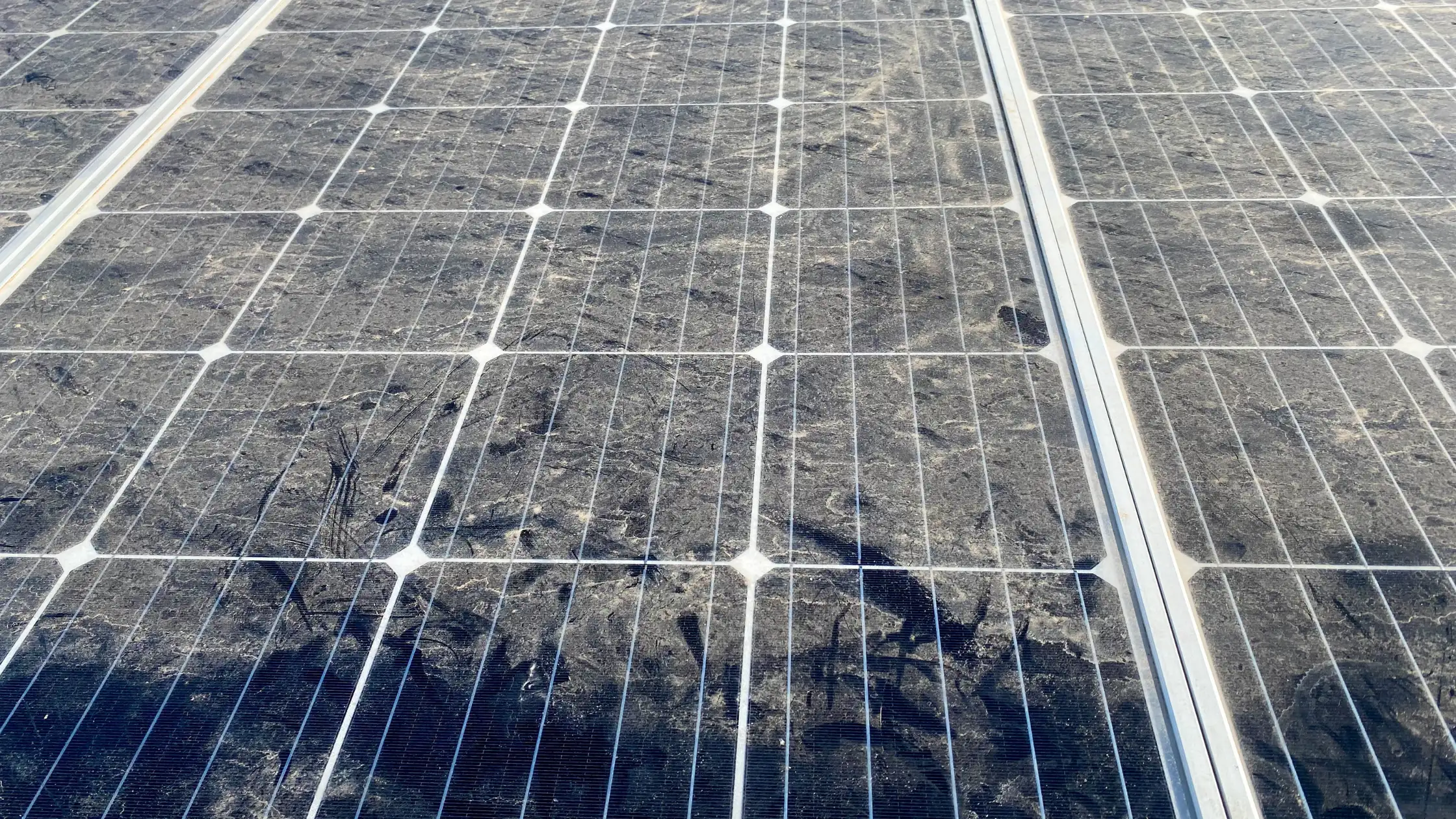
More critically, the soiling that does occur during monsoon is qualitatively different and more damaging. Duke University researchers studying Gandhinagar found that monsoon rain reduces deposited PM10 mass by 90% but more than doubles PM2.5 deposition. Fine particles in humid conditions trigger cementation reactions, calcium carbonate, carbon-rich crusts, and in some cases fungal growth detectable within three weeks. These deposits are not removed by subsequent dry cleaning and can become permanent if not addressed early in the post-monsoon window.
Season 3: Post-Monsoon (October – November), The Performance Peak That Requires Protection
Post-monsoon is India's solar performance sweet spot: irradiance recovers, temperatures moderate, dust deposition slows. Performance Ratios of 82–87% are achievable in this window at well-maintained plants in Rajasthan and Gujarat. The 2022 study recorded soiling loss of 0.24%/day in this period, the lowest outside monsoon itself.
However, this is also the window when post-monsoon cementation damage compounds quietly. Panels that were not cleaned immediately after monsoon exit (September–October) carry PM2.5 cement deposits into the high-generation window, permanently reducing output until the next wet cleaning cycle. O&M teams that skip the post-monsoon deep clean sacrifice the most valuable generation quarter of the year.
Season 4: Winter (December – February), Moderate Soiling, High Agricultural Dust in North India
Winter soiling is higher than monsoon but lower than pre-monsoon. The 2022 study recorded 0.34%/day in winter. North Indian plants face a specific challenge: crop residue burning in Punjab and Haryana from October to November generates particulate-heavy haze that migrates south and west, affecting plants in Rajasthan, MP, and UP. PM2.5 concentrations in Delhi and surrounding regions regularly exceed 200 µg/m³ during this period, a fraction of which settles on panel surfaces within days.
Winter also brings fog in north India (particularly January), which deposits fine water droplets carrying particulate. Fog-deposited soiling is denser and harder to remove than wind-blown dust and requires brushing force calibration for dry-cleaning systems.
Seasonal Soiling Rate Summary Table
Season | Months | Daily Soiling Rate | Monthly Energy Loss (if uncleaned) | Primary Cause |
|---|---|---|---|---|
Pre-Monsoon | Mar – Jun | 0.35 – 0.50%/day | 10 – 15% | Desert dust, agricultural dust, dry winds, andhi storms |
Monsoon | Jul – Sep | 0.10 – 0.24%/day | 3 – 6% (soiling only; irradiance loss separate) | PM2.5 cementation, humidity, fungal growth |
Post-Monsoon | Oct – Nov | 0.20 – 0.30%/day | 5 – 8% | Residual particulate, post-rain cementation compounds |
Winter | Dec – Feb | 0.25 – 0.34%/day | 7 – 10% | Fog deposition, crop burning haze, industrial PM |
How Soiling Rate Translates to Energy Yield Loss by Plant Location
Not all 100 MW plants are affected equally. The table below illustrates approximate annual yield loss from soiling alone (assuming no cleaning) for representative plant locations.
Location | Climate Zone | Annual Soiling Loss (No Cleaning) | Annual Soiling Loss (Weekly Cleaning) |
|---|---|---|---|
Barmer / Jodhpur, Rajasthan | Hot arid desert | 30 – 40% | 4 – 7% |
Kutch / Banaskantha, Gujarat | Hot arid / semi-arid | 25 – 35% | 4 – 6% |
Gandhinagar / Mehsana, Gujarat | Hot semi-arid | 15 – 25% | 3 – 5% |
Bundelkhand, MP | Tropical dry | 15 – 20% | 3 – 4% |
Pavagada / Tumkur, Karnataka | Tropical semi-arid | 10 – 15% | 2 – 3% |
Coastal Andhra / Tamil Nadu | Tropical coastal | 8 – 12% | 2 – 3% |
What This Means for O&M Scheduling
A static cleaning schedule, say, Monday and Thursday every week year-round, is financially suboptimal. The correct approach is dynamic scheduling based on soiling rate, not calendar date.
The research-backed optimal cleaning frequency calculation is:
Optimal interval (days) = √(2 × Cleaning Cost per MW) / (Daily Soiling Rate × Revenue per kWh × Plant Capacity kWh/day)
In practical terms for a 50 MW plant in Rajasthan at peak pre-monsoon soiling:
Daily soiling rate: 0.45%/day → 225 kWh/day lost per MW at 1.4 MWh/MW/day peak output
Revenue: ₹3.50/kWh → ₹787 lost per MW per day
Robotic cleaning cost: ~₹800–1,500 per MW per cycle (TAYPRO OPEX contract range)
Optimal cleaning frequency: every 1–2 days
In monsoon, the same calculation with 0.20%/day soiling and reduced irradiance shifts the optimal frequency to every 10–14 days, and rain events substitute for mechanical cleaning in heavy-monsoon zones.
How TAYPRO's NECTYR Platform Manages Seasonal Variation
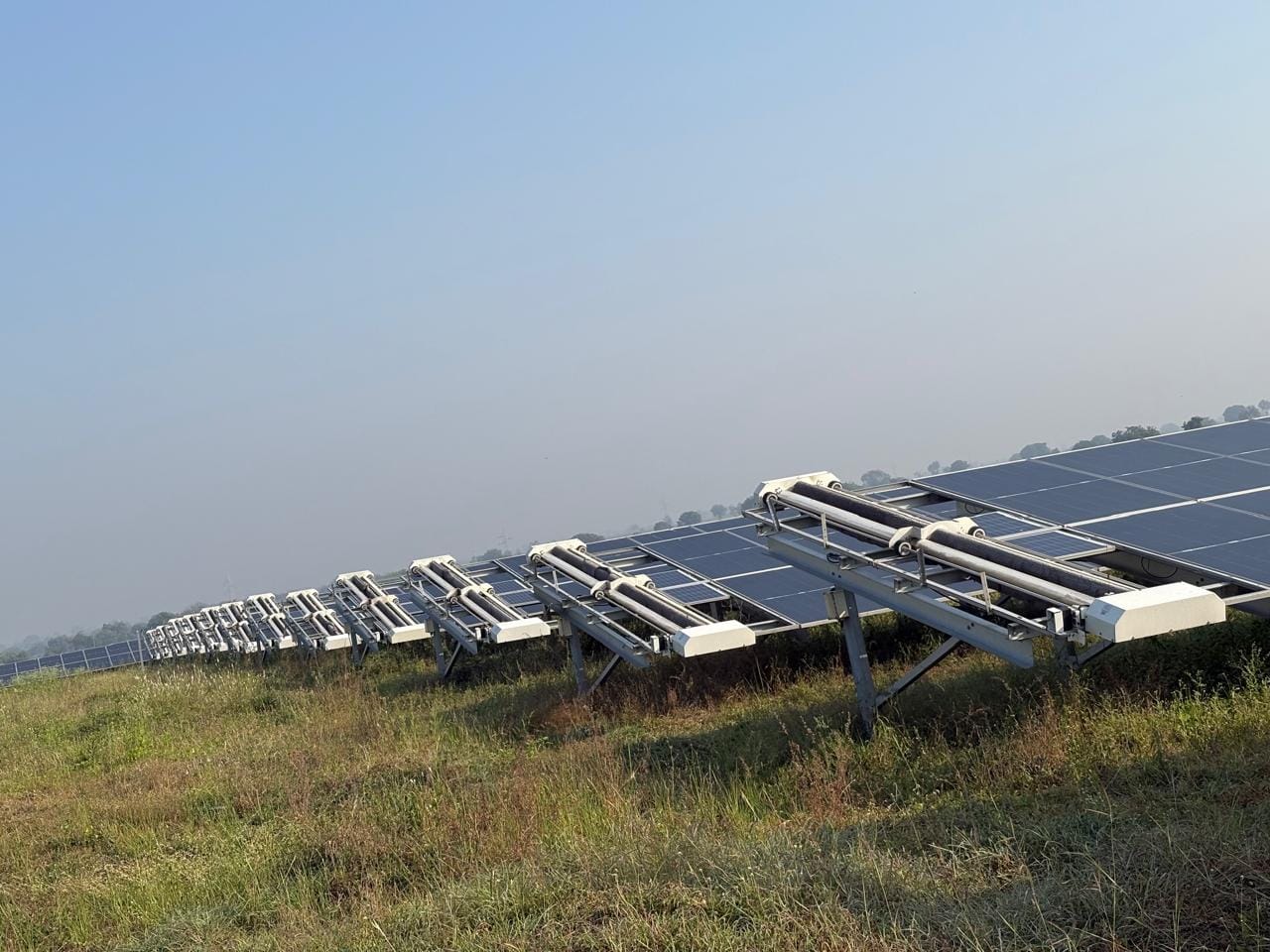
TAYPRO's NECTYR fleet management software moves cleaning scheduling from calendar-based to performance-based. The system monitors PR deviation at string level in real time. When string-level PR drops beyond a defined threshold, calibrated per season and per site, NECTYR dispatches the GLYDE or GLYDE-X robot on that row. This means cleaning frequency automatically increases in pre-monsoon and winter, reduces during monsoon, and peaks again in post-monsoon when generation recovery per cleaning event is highest.
Across TAYPRO's deployed fleet (5 GW+ of solar capacity), NECTYR data shows that plants using performance-triggered cleaning improve annual PR by 3–5 percentage points compared to plants using fixed weekly schedules, the equivalent of 3–5% more generation from the same asset, at zero additional capex.
Related resources
For procurement and O&M teams evaluating robotic cleaning in India:
- Taypro robotic solar panel cleaning service
- solar panel cleaning robot price guide for India
- solar panel cleaning robots in Rajasthan
Related reading
Frequently asked questions
Pre-monsoon (March–June) is the highest soiling season in India, with daily soiling rates of 0.35–0.50%/day in arid regions. Monthly energy losses of 10–15% from soiling alone are documented in peer-reviewed studies for this period in Rajasthan and Gujarat.
Partially. Monsoon rain removes coarse PM10 particles (90% reduction in mass), but research in Gandhinagar found that PM2.5 deposition more than doubles after rain. The fine particles cause cementation and fungal growth on panel surfaces that rainfall cannot remove and that requires mechanical cleaning in the post-monsoon window.
Optimal approach: daily or every-other-day cleaning in pre-monsoon (April–June), reduce to every 10–14 days during monsoon, increase to every 3–5 days in post-monsoon (October–November) due to high generation value per cleaned unit, and every 4–7 days in winter depending on fog and crop-burning PM levels at the specific site location.
A well-managed plant with robotic dry cleaning at appropriate seasonal frequency achieves residual soiling losses of 2–5% annually. A poorly managed plant relying on manual wet cleaning at fortnightly intervals in Rajasthan or Gujarat can lose 15–25% of annual generation from soiling alone, representing several crore rupees per year at 50–100 MW scale.
Soiling is a direct PR deduction. A plant with a theoretical PR of 82% operating during a high-soiling pre-monsoon month with 12% accumulated soiling loss effectively posts a field PR of 72% — well below lender covenants and PPA performance guarantees. Seasonal soiling modelling should be a standard input in PPA performance ratio calculations, not an afterthought.